
What's the best starter feeding ratio (that actually works)?
The best starter feeding ratio is commonly either 1:5:5 or 1:10:10. In the case of 1:5:5 that's 1 part old starter, 5 parts flour and 5 parts water. If you are using a stiff starter, use half the amount of water. So that's 1:5:2.5. Depending on when you last fed your starter 1:10:10 might make more sense.
The short version
- 1:5:5 is the default: 1 part old starter, 5 parts flour and 5 parts water, for example 10 g, 50 g and 50 g. For a stiff starter, halve the water: 1:5:2.5.
- More fresh flour, later peak. Feed 1:10:10 when your kitchen is very warm or when you want to bake about a day after feeding.
- Too sour? Feed less old starter, once a day. A stiff starter shifts the balance even further toward the yeast.
- New starter, same ratio. From day 2, keep 10 g and feed it 50 g flour and 50 g water. The full method is in my starter recipe.
The rule of thumb
If the starter is old and hasn’t been fed recently the 1:10:10 ratio is a better choice. By reducing the starter inoculation ratio, you provide the microorganisms with a cleaner environment. This way they can reproduce and regrow into a more desirable balance to begin your dough fermentation.
Generally, think of your sourdough starter as a dough. Use the same ratios you use for your bread dough for your starter. Your starter should be trained in the same environment that you later use for your dough. This way your starter is perfectly suited to ferment the dough into which it is later inoculated.
This also holds for a brand new starter. From day 2, take 10 g of the previous day’s mixture and feed it 50 g flour and 50 g water, so 1:5:5 from the very start.
Why not 1:1:1?
Some bakers refresh their starter at 1:1:1, or use it for the first days of a new one. I don’t. Your starter is a miniature dough, and you would never mix a bread dough with as much starter as flour. 1:5:5 works out to 20 % starter on the flour and 1:10:10 to 10 %, the same range I use in a dough.
What the three numbers mean
The order is always starter, flour, water. How much water you feed relative to the flour also sets your starter type, so you can switch types just by changing it:
| Starter type | Hydration | Feeding example | Favors |
|---|---|---|---|
| Regular | 100 % | 1:5:5 | Yeast and bacteria in balance |
| Stiff | 50 to 60 % | 1:5:2.5 | Yeast: more rise, less acid |
| Liquid | about 500 % | 1:5:25 | Bacteria: milder, dairy-like acidity |
Keep a new ratio for 2 to 3 feedings, one a day, so the microbes can adapt. Going liquid changes your starter for good, so keep a backup first. If I had to choose one type, it would be the stiff starter. That’s why my own ratio is almost always 1:5:2.5.
A bigger ratio means a later peak
The more fresh flour each part of old starter gets, the longer it takes to be ready again. That makes the ratio your scheduling tool: if your starter is usually ready after 6 hours and you need it later, feed it more flour and water. With very little starter left, I go as far as 1:50:50 or 1:100:100.
Check it 6 to 12 hours after feeding: look at the growth, the bubbles at the edge of the jar and the smell. It doesn’t have to double, because rye and weaker wheat flours hold less gas. Use it just before it collapses, rather a little early than too late. If you are late, use less of it in your dough, for example 10 % instead of 20 %.
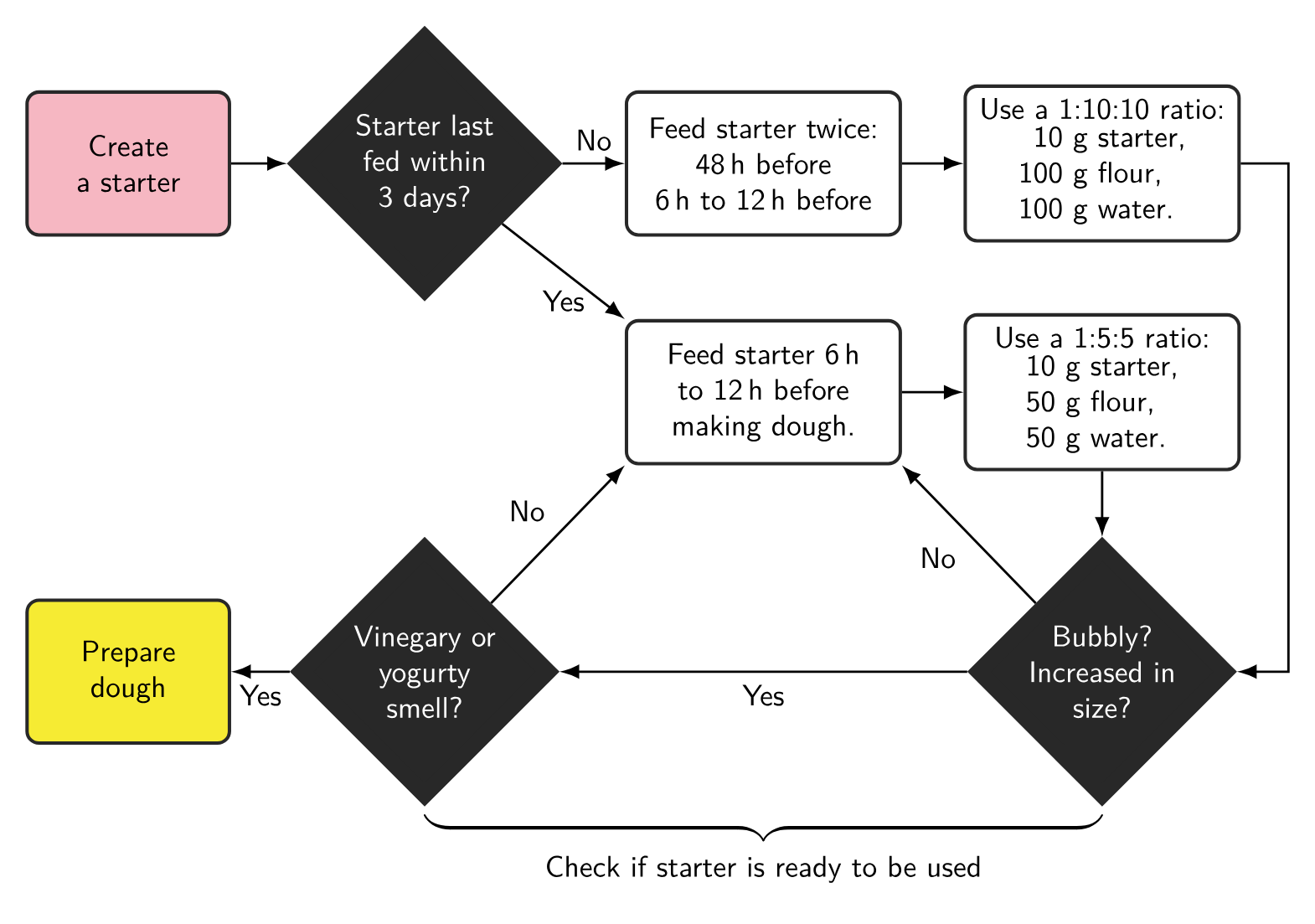
Flowchart 7.2 from my free book The Sourdough Framework: The process to check your sourdough starter when making wheat-based doughs. With a stiff starter you would have half the shown water quantities, i.e., if the chart shows 100 g of water, use 50 g to 60 g of water.
Less old starter, less sourness
When a starter sits unfed for long, the bacteria take over and the piled-up acid holds the yeast back. Your dough inherits that: sour and not as fluffy as it could be. Daily feedings at room temperature with a small share of old starter, 1:5:5 or 1:10:10, shift the balance back toward the yeast. Early on my starter needed 2 to 3 feedings for that. Now one is usually enough.
A mild, yogurt-like smell means lactic acid. Sharp vinegar, sometimes glue or acetone, means acetic acid. The stronger the smell, the less starter you should use. And for the same rise, a stiff starter builds up the least acid. If your bread keeps coming out too sour, try one. For me it was a game changer.
Temperature
Warmth speeds fermentation up and cold slows it down. In a very warm kitchen I feed 1:10:10, or 1:10:5 or 1:20:10 for a stiff starter, so it doesn’t ripen too fast. Below about 4 °C (40 °F) fermentation almost stops, and the colder the starter, the longer it keeps a good balance of yeast and bacteria. In the fridge, keep a little water on top so the surface can’t dry out. Mold needs air and doesn’t grow well under water.
Pick a ratio for your schedule
| Your plan | What I do |
|---|---|
| Mix tomorrow morning | 1:5:5 (stiff: 1:5:2.5) the evening before, 6 to 12 hours ahead |
| Hot kitchen, or baking 24 hours after feeding | 1:10:10 (stiff: 1:10:5 or 1:20:10) |
| Very little starter left | 1:50:50 or 1:100:100, with more time |
| Fed in the morning, no time to mix in the evening | Don’t feed again. Mix next morning with about 5 % starter, 1 % after two days unfed |
| Bake next week | Fridge, under a little water, then 1 or 2 feedings at room temperature |
| Pause for several months | Dry the starter |
Feeding is the more reliable option. Cutting the starter amount works, but fresh feedings make better bread, and at 1 % a wheat dough needs a strong flour. If you bake often, feed once a day at room temperature. Otherwise keep the starter in the fridge and feed it about once a week. You don’t need several feedings a day: good bread comes from reading your fermentation, not from a feeding ritual.
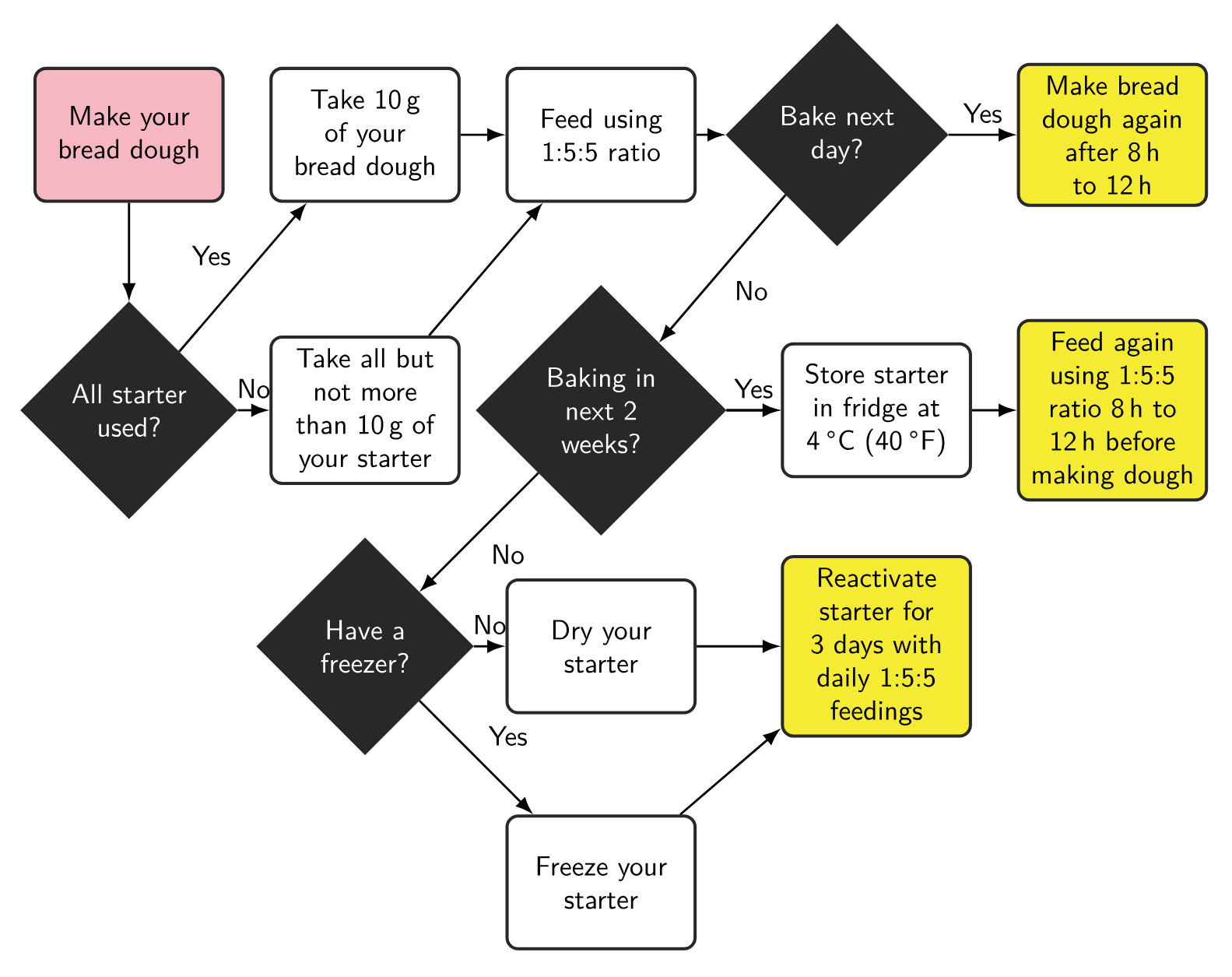
Flowchart 3.3 from my free book The Sourdough Framework: A full flowchart showing you how to conduct proper sourdough starter maintenance. You can use a piece of your dough as the next starter. You can also use left-over starter and feed it again. The chart assumes a starter at 100 % hydration; adjust the water accordingly for a stiff starter.
You can read more on the topic in my free sourdough book. Head to the chapter covering sourdough starter basics.